


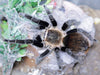

Tliltocatl (Brachypelma) kahlenbergi (Veracruz Red-rump Tarantula) 0.5-0.75" FREE AFTER $100 SPENT
Pickup available at Home Office
Usually ready in 2-4 days
%20kahlenbergi%20(Veracruz%20Red-rump%20Tarantula)%200.5-0.75%22%20FREE%20AFTER%20$100%20SPENT)
✅ Live Arrival Guarantee: reship if reported within 2 hours, or replaced on your next order within 24.
Description
Tliltocatl (Brachypelma) kahlenbergi (Veracruz Red-rump Tarantula)
The Veracruz Red-rump, or Tliltocatl kahlenbergi (ex. Brachypelma), is a terrestrial tarantula from the Veracruz region of Mexico. Adults of this species have velvety black legs and a black body with a deep red abdomen, creating a beautiful high contrast coloration similar to its cousin, the Mexican red rump. Spiderlings do not start out colorful and the adult colors come in around 2 to 2.5 inches, while the species only grows to about 5 inches in diagonal leg span. Like others in the genus, along with Brachypelma, this species has a very long lifespan, with females reaching about 20 years while males live 3 to 5 years. This species is also very calm and forgiving, and one we recommend for beginner keepers or anyone who wants an easier keeping experience. This one is available free with a qualifying invertebrate purchase. Grab this docile new world tarantula for sale today, offered here as a spiderling.
Why do hobbyists keep Tliltocatl kahlenbergi?
- Free Invertebrate: Yours at no cost with a qualifying invertebrate purchase, which covers tarantulas, spiders, centipedes and scorpions.
- Deep Red Abdomen: Velvety black legs and a black body with a deep red abdomen as it matures, a high contrast animal rather than a subtle one.
- Docile Temperament: Calm and slow to react, so a free sling here is not a difficult sling.
- Beginner Species: This species is very forgiving in its care for newer keepers who are still learning how to keep spiderlings and tarantulas.
- Uncommon in the Hobby: Most collections do not have one, which makes it a far better freebie than another of the usual starter species.
How should the Veracruz Red-rump be kept?
- Adult Size: These hatch out around half an inch (0.5 inch) and reach a max size of around 5 inches at full leg span, with the adult coloration coming in around 2 to 2.5 inches. That is a lot of growing to watch and two enclosure upsizes to plan for along the way.
- Enclosure: This size calls for a 6 by 6 by 4 inch enclosure with about 2 inches of substrate and a hide such as a piece of cork bark to shelter under. We build to roughly 3 times the leg span for footprint and 2 times for height on terrestrials, and we size for where the animal is headed rather than where it sits today, so this is built for a 2 inch spider. That is a third of adult size, which means one enclosure carries it through years of growth. Consider sizing up one notch to 8 by 8 by 5 inches for extra room.
- Rehousing: Three enclosures for life, two rehouses total. Next is a 12 by 12 by 8 inch setup with about 4 inches of substrate once it hits roughly 2 inches, then an 18 by 18 by 12 inch adult enclosure with 6 inches of substrate around the 4 inch mark. This is a slow growing species, 4 to 6 years to full size, so expect roughly 18 to 24 months out of each enclosure. Males mature considerably faster than females and often never need the third one.
- Temperature: Keep between 65 and 75 degrees F.
- Humidity: This is an arid species, so it is not one you keep wet. Let the substrate sit mostly dry and simply make sure it never dries out completely. At sling size we keep one damp corner going at all times, usually by overfilling the water dish and letting it wick in, since small spiders lose moisture faster than adults do. Organic coconut fiber works well here because it resists mold and lets you keep that gradient. Good ventilation is critical. Cross ventilation works best, but ample top ventilation can also be effective as long as the enclosure is not over-misted.
- Water: A shallow textured water dish works well, something they can grip when climbing out.
- Diet: Prey length should run about a quarter of the leg span, which is roughly the width of the carapace (head). At half an inch to three quarters of an inch that means a 0.125 to 0.19 inch cricket or a small roach nymph. Crickets, roaches and mealworms all work. Feed at least once a week.
- Temperament: Docile and slow to react, hardy and tolerant of a range of conditions, which is exactly why this genus is recommended as often as it is.
Are there any additional notes or considerations for the Veracruz Red-rump?
- Solitary Species: House individually. Attempts at cohabitation can end in cannibalism, so one animal per enclosure with this genus.
- Mexican Endemic: One of the red rump tarantulas out of Mexico, from the Veracruz region, which is where the common name comes from and how it is told apart from the other red rumps in the genus.
- Freebie Terms: Our invertebrate freebies are only valid on purchases of invertebrates, meaning tarantulas, spiders, centipedes and scorpions. They do not apply to reptiles, dry goods or merch.
- Lifespan: Like others in the genus, and like Brachypelma, this species has a very long lifespan. Females reach about 20 years while males live 3 to 5, so a female bought at any size is a decades long animal rather than a season.
- Slow Grower: Four to six years to full size, so this is a free animal that stays interesting for years rather than a throwaway add on.
- Captive Bred: All Tarantulas are 100% captive bred.
Listing Notes
- This listing is for a Tliltocatl kahlenbergi Veracruz Red-rump spiderling measuring around half an inch to three quarters of an inch (0.5 to 0.75 inch) in diagonal leg span, which is the size given in the title, unsexed with roughly a 50/50 chance of male or female, and it is available free with a qualifying purchase of invertebrates, which includes tarantulas, spiders, centipedes and scorpions. Our invertebrate freebies are only valid on invertebrate purchases and do not include reptiles, dry goods or merch. This is about the size the species hatches at, which is normally your cheapest way to collect it, and here it costs nothing at all. It is a species most collections do not have, and raising one from here is how the deep red on the abdomen comes in molt by molt.
How our rewards and freebies work
How does the Exotics Unlimited rewards program work?
Our rewards program has three parts and they work together instead of cancelling each other out. Subscribe to our email list for free and you get 10% off invertebrate orders as an ONYX member, climbing to GOLD at 13% once your lifetime spend passes $1,000 and PLATINUM at 15% past $3,000. Any single pet invertebrate order over $1,200 takes 20% off on its own, whatever tier you are. The one exception is items already marked down for a weekly deal or an event special. Those say so in the title, and the discount is already built into the price. If your total after that discount reaches $300, shipping to a FedEx facility for pickup is free. And your freebie credit is built from that same total, so you are choosing free animals on top of both. Feeders and supplies get a flat 5% for subscribers, separate from the invertebrate discount.
A $340 invertebrate order is the clearest way to see it. Your 10% brings it to $306, that clears the $300 mark so facility pickup is free, and that same $306 is your freebie credit to spend on animals you pick yourself. One order, all three benefits. Full tier breakdown on our VIP program page.
What is a freebie tarantula and how do I get one?
Exotics Unlimited gives away free tarantulas, true spiders, scorpions, and centipedes with qualifying invertebrate orders. Most shops call this a free gift with purchase. Ours works differently because you choose the animal instead of us picking one for you.
Every freebie says so right in its title, like FREE AFTER $150 SPENT. That line is what makes something a freebie, so if a product does not carry it, it is not one. Older freebie listings stay up around the site after they sell out, so the Freebies page is the one to shop. It is where the current lineup lives.
Your freebie credit equals your pet invertebrate subtotal after discounts and before shipping. Dry goods, feeders, supplies, and enclosures do not count towards your credit.
How much do I have to spend to get a free tarantula?
Freebies start at just $25. Free tarantulas and other invertebrates start at $50. Every freebie shows its cost in the title: FREE AFTER $150 SPENT means you need $150 in credit. Thresholds range from $25 up to $800 for rare species. Not looking for another animal? We also offer freebie merchandise like stickers, so there is always something to claim.
Can I get multiple free tarantulas in one order?
Yes. There is no cap on how many you take, only on what they add up to. Mix and match anything you want, including multiples of the same species, as long as their combined cost fits your freebie credit. With $350 in credit you could take one $350 species, two $150s plus a $50, or seven $50 spiderlings. Freebie programs across the hobby often limit you to one per species or one per spend tier. Ours does not work that way. If your credit covers it, take as many as you would like.
What makes your rewards program different from other tarantula shops?
Most rewards programs make you pick one: take the discount or take free shipping. Ours run together, and freebies sit on top of both. That is the part people notice first.
The rest of it: subscribing is free and gets you 10% off invertebrates for as long as you stay subscribed rather than a one-time welcome code, and it climbs to 13% and 15% as your lifetime spend passes $1,000 and $3,000. You choose your own freebies instead of receiving whatever a shop decides to send. And there is no cap on how many you take, only on what they add up to, where most reward and loyalty programs limit you to one free item per order or one per spend tier.
Freebie thresholds start at $25 and free animals start at $50, so the program is doing something on nearly every order rather than only on big ones.
Do I really get 10% off just for subscribing to the email list?
Yes. Subscribing is free and it takes 10% off every pet invertebrate we sell, tarantulas, true spiders, scorpions and centipedes included. It stays active for as long as you are subscribed. Most shops hand you a one-time welcome code. This one keeps working.
From there it climbs with your lifetime spend, 13% past $1,000 and 15% past $3,000, and any single order over $1,200 takes 20% regardless of tier, with nothing to claim or remember. It applies itself at checkout and you do not need to be logged in for it to work. Subscribers also get 5% off feeders and supplies. That one is a flat 5% for every subscriber and does not climb with your tier, but it applies for as long as you stay subscribed just like the rest. Items already marked down for a weekly deal or an event special are the one exception. The discount is built into the price on those, so a subscriber discount does not come off on top. You will always know which ones they are because it says so right in the title, the same way freebies do.
Does my VIP discount change my freebie credit?
Your discount comes off first, and the total after it is what builds your freebie credit. So a $340 invertebrate order at 10% leaves $306, and that $306 is both your freebie credit and enough to clear the $300 free shipping mark.
That is worth knowing when you are close to a threshold, because the number that counts is the one after your discount. You never have to work it out yourself though. The calculator on the Freebies page always shows your real credit.
Why does it say I don't qualify for my freebies?
You can add any freebies you want to your cart, but you will need enough freebie credit to cover all of them. If you are short, the calculator on the Freebies page shows exactly how much more to add in pet invertebrates.
Freebies will still show as $0.00 in your cart either way. That is just how they are priced. What matters is whether your credit covers their total cost before you check out. If it does not, we will reach out to sort it before your order ships.
Does my qualifying total carry over from a previous order?
No. Your qualifying total for free shipping and freebies is based on your box, not a running balance. You can combine as many orders as you want into one box before it ships, and the combined total (after discounts) is what counts toward free shipping and freebie credit. Once that box ships, the total resets, a new order placed afterward starts fresh and does not carry over from a box that has already shipped.
If you want to build toward free shipping or more freebies, add to your order before it ships rather than placing a new one after.
What happens if I check out with more freebies than I qualify for?
Do not worry, we will reach out as soon as possible to help you get your freebies sorted before your order ships. We will work with you to either adjust your selection or add to your order to cover them. We never remove or swap your freebies without letting you know first.
To avoid the back-and-forth, check your freebie credit in your cart before checking out. We will always show you exactly where you stand.
What happens if my free tarantula arrives DOA?
Freebies are covered exactly like paid animals. There are two reporting windows and they buy different things.
Report within 2 hours of delivery and we reship. That is the full guarantee. A fast report tells us the problem came from transit, and it gives us the best shot at making it right properly.
Report within 24 hours and we replace it on your next order. You are still covered, the replacement just travels with your next shipment rather than going out on its own.
The 2 hour window is for FedEx facility pickup. Home delivery is 30 minutes, because by then the package has spent longer on a truck that is not temperature controlled. Either way, tell us the moment you see a problem rather than waiting.