


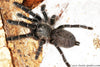

Pterinochilus murinus "Black" Botswana-Zimbabwe (Black & White Gold Baboon Tarantula)
Pickup currently unavailable at Home Office
)
Description
Pterinochilus murinus 'Black' (Black Baboon Tarantula)
The Black Baboon Tarantula, or Pterinochilus murinus, is an Old World terrestrial tarantula, and this Botswana-Zimbabwe color form is the darkest and rarest of the three forms we offer. Unlike the bright orange RCF and Usambara forms of this species, adults of the Black form have a black base across the legs, carapace (head), and abdomen, accented with white and gold highlights that catch the light as it moves. Even as spiderlings, that dark coloration is already developing and only deepens with every molt, and this species only grows to about 4 to 5 inches in diagonal leg span, with a fast growth rate that gets it to full size in as little as 1 to 2 years. This species also has a long lifespan, with females reaching about 8 to 12 years while males live 2 to 3 years. This is a fast, reactive, bold display species, and one we recommend for keepers who already have some tarantula experience and want a high-energy animal to watch. Grab this rare Black Baboon Tarantula for sale today, offered here as a spiderling.
Why do hobbyists keep the Black Baboon Tarantula?
- Black, White and Gold Coloration: This Botswana-Zimbabwe form carries a dramatic black base accented in white and gold, a striking departure from the bright orange forms of this species.
- Heavy Webber: This species webs constantly and extensively, often connecting its hide to the surface with a dense sheet web that becomes part of the display on its own.
- Great Display Species: It rarely stays buried for long and is quick to come out at the slightest vibration, so you actually get to see the animal you bought.
- Fast Grower: With a fast growth rate, this species reaches full size and full display value sooner than most terrestrials in the hobby.
- Rare Color Form: The Black Botswana-Zimbabwe form is far less common in the hobby than the classic RCF or Usambara forms, making it a standout pickup for collectors chasing something different.
How should the Black Baboon Tarantula be kept?
- Adult Size: Hatchlings start around 0.5 to 0.75 inch, and adults reach about 4 to 5 inches in diagonal leg span. Each size below has its own exact enclosure dimensions and prey measurement.
- Enclosure: Enclosure sizing depends on which size you choose below, each size page gives the exact dimensions for that animal.
- Rehousing: The cage path for this species runs from a small starting enclosure up through two more sizes as it grows; each size page below tells you exactly where that animal is on that path.
- Temperature: 75 to 85 degrees Fahrenheit, the optimal range for most tropical and savanna species like this one. Cooler temperatures are survivable, but increase the odds of trouble molting and growing, so we recommend staying in this range for the best results. Most keepers do not need any extra heating to hit it.
- Humidity: Moderate humidity with good cross ventilation works well. Keep the substrate mostly dry and avoid overly damp conditions, misting lightly only if it has gone bone dry for an extended stretch.
- Water: A shallow textured water dish works well, something they can grip when climbing out.
- Diet: At this size, prey should measure about a quarter of its current leg span, listed on each size page, roughly the width of the carapace (head). Offer food at least once a week.
- Temperament: Skittish and quick to react, more likely to bolt for cover or flare up at a disturbance than sit still, which is exactly what makes feeding time so entertaining to watch. It is not a handled species, but it is a hardy, forgiving one to raise, tolerant of small care mistakes while it grows.
Which size should I choose?
- 0.75-1" Spiderling: Our starting size for this rare color form, and your cheapest way to collect it from a young age.
- 1-1.25" Spiderling: A bit further along than our smallest size, with the black coloration already beginning to show.
- 2-2.5" Juvenile: A larger, well-started animal for anyone who wants to skip past the earliest and most delicate stage.
Are there any additional notes or considerations for the Black Baboon Tarantula?
- Captive Bred: All tarantulas at Exotics Unlimited are captive bred.
- About the Color Form: This locality is sometimes called the Botswana or Zimbabwe form, and is the rarest and darkest color form of Pterinochilus murinus we carry.
Frequently asked questions about the Black Baboon Tarantula
- What is the difference between the RCF, Usambara, and Black Botswana-Zimbabwe forms? All three are the same species, Pterinochilus murinus, differing only in color form and locality. RCF is the classic, brightest red-orange version. Usambara, named for the Usambara Mountains of Tanzania, carries a warmer, more golden yellow-orange. The Black Botswana-Zimbabwe form is the darkest and rarest, with a black base accented in white and gold. Care is identical across all three; only the coloration and origin differ.
Have a question? Ask an expert!
Share information about your brand with your customers. Describe a product, make announcements, or welcome customers to your store.