


Ephebopus cyanognathus (Blue Fang Tarantula) 0.75-1"
Pickup available at Home Office
Usually ready in 2-4 days

✅ Covered by our 24 Hr Live Arrival Guarantee!
Description
Ephebopus cyanognathus (Blue Fang Tarantula)
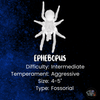
The Blue Fang Tarantula, or Ephebopus cyanognathus, is a fossorial tarantula from French Guiana. Spiderlings hatch out with bright orange legs, blue fangs, a shiny emerald green abdomen, and gold banding on the legs, then gradually shift into an olive toned adult with purple fangs and yellow leg banding as they grow. This species only grows to about 4.5 inches in diagonal leg span, with a fast growth rate. This species also has a long lifespan, with females reaching about 10 to 15 years while males live 2 to 3 years. This species is more defensive than many New World tarantulas, especially while young, and is one we recommend for keepers who want a tarantula with real attitude and presence. Grab this new world tarantula for sale today, offered here as a spiderling.
Why do hobbyists keep Ephebopus cyanognathus?
- Drastic Color Change: Few tarantulas transform as completely as this one. A spiderling with orange legs, blue fangs, and an emerald green abdomen slowly becomes an olive adult with purple fangs and yellow leg banding.
- Bright Blue Fangs: The fangs stay blue at every life stage before shifting to purple as an adult, a feature almost no other tarantula in the hobby shares.
- Heavy Webber: Builds dense burrows reinforced with silk, especially as it matures into a dedicated burrower.
- Fast Grower: With a fast growth rate, this species reaches its full adult size and coloration sooner than many comparable tarantulas, so you do not wait as long to see the payoff.
- Great Display Species: Slings spend more time climbing and out in the open before settling into the adult's underground lifestyle, so you get to watch this species from two completely different angles.
How should Ephebopus cyanognathus be kept?
- Adult Size: Hatches around 0.5 to 0.75 inch and reaches about 4.5 inches at full leg span, so there is plenty of growing left ahead of this size.
- Enclosure: A 2 by 2 by 3 inch enclosure is plenty of room at this size, with at least 1.5 inches of substrate so it can begin practicing the burrowing behavior it will rely on as an adult.
- Setup Tips: Add a piece of cork bark or wood for climbing. Slings of this species are still spending real time off the ground, so a vertical surface alongside the substrate helps it settle in faster.
- Rehousing: At a fast growth rate, expect to size up to around a 5 by 5 by 8 inch enclosure within about 6 to 8 months, then up again toward a 10 by 10 by 14 inch enclosure as it approaches its 4.5 inch adult max.
- Temperature: Keep between 75 and 85 degrees Fahrenheit, the optimal range for this tropical species. Cooler temperatures are survivable, but increase the odds of trouble molting and growing, so we recommend staying in this range for the best results. Most keepers do not need any extra heating to hit it.
- Humidity: Never let the substrate dry out completely. This is a tropical species and it likes things a little wetter than most terrestrials, so keep it slightly damp and top it up before it goes dry rather than after.
- Water: Provide a shallow water dish placed in an elevated position if possible. This is more natural while it is still behaving arboreal and helps prevent crickets from falling in and drowning. A weekly misting is suggested as well, so the animal can drink off the side of the enclosure or its own webbing if it prefers that to the dish, as long as you are wetting surfaces rather than soaking the substrate.
- Diet: Crickets, roaches, or dubia sized from about 3/16 to 1/4 inch, matching the width of the carapace (head). Feed at least once a week.
- Temperament: Defensive and quick to throw a threat posture at this age, noticeably calmer once it settles with age.
Are there any additional notes or considerations for Ephebopus cyanognathus?
- Changes Lifestyle With Age: Slings spend more time climbing and using vertical space, while adults shift into a fossorial, burrowing lifestyle, so enclosure setup should evolve as it grows.
- Captive Bred: All tarantulas at Exotics Unlimited are captive bred.
Frequently asked questions about Ephebopus cyanognathus
- Why is my Blue Fang spiderling climbing instead of burrowing? That is completely normal for this species. Slings behave more arboreal and spend real time off the ground, and the shift into the fossorial, burrowing adult lifestyle this species is known for happens gradually as it grows.
Listing Notes
- This listing is for an Ephebopus cyanognathus Blue Fang Tarantula spiderling measuring around 0.75 to 1 inch in diagonal leg span, which is the size given in the title, unsexed, with roughly a 50/50 chance of male or female.
- Looking for other sizes? This species is also available as a 0.5-0.75" Spiderling, 2-2.5" Female Juvenile, 2.5" Juvenile, 3.5-4" Mature Female, or Matured Male about 3.5".