


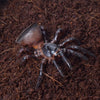
Cyclocosmia latusicosta (Chinese Hourglass Trapdoor) 2" WEEKLY DEAL
Pickup available at Home Office
Usually ready in 2-4 days
%202%22%20WEEKLY%20DEAL)
Cyclocosmia latusicosta (Chinese Hourglass Trapdoor Spider)
There is nothing else in the hobby that looks like this. The Chinese Hourglass Trapdoor is one of the most bizarre and fascinating spiders available anywhere — and once you see that abdomen, you will understand immediately why hobbyists lose their minds over it. The rear of the abdomen is heavily armored, circular, and disc-shaped, with a hardened plate ringed by backward-facing setae that gives it the unmistakable "oreo butt" or "coin butt" look that has made this species famous online. That armored disc is not just for show — it is a functional defense shield. When threatened, this spider retreats to the bottom of its burrow and plugs the entrance with its abdomen, the backward-facing setae locking it in place and making it nearly impossible to extract. Native to China, this compact, heavily built trapdoor spider constructs deep burrows capped with a trapdoor lid and spends its entire life perfecting that tunnel. Compact at around 3 inches but absolutely loaded with personality and behavior. Grab this trapdoor spider for sale today if you want the most uniquely adapted burrowing spider in the hobby.
Why do hobbyists keep Cyclocosmia latusicosta?
- The Abdomen: That circular, coin-shaped, hardened disc on the rear of the abdomen is unlike anything else in the hobby. Called the "oreo butt" or "coin butt" by hobbyists, it has to be seen in person to be fully appreciated. It is the single most recognizable feature of any spider in the trade.
- Defense Behavior: When discovered in its burrow, this species retreats to the bottom and plugs the entrance with its armored abdomen. The backward-facing setae lock it in place like an anchor. Watching this behavior is one of the most remarkable things you will see from any captive spider.
- Trapdoor Construction: Constructs deep burrows capped with a hinged trapdoor lid built from soil and silk. Given the right substrate and conditions, this natural engineering behavior plays out in full in captivity.
- Rarity: Cyclocosmia latusicosta is not a production species. When available it moves fast and may not appear again for a long time.
How should Cyclocosmia latusicosta be kept?
- Adult Size: Reaches around 3 inches. Compact but heavily built, with a uniquely wide, disc-shaped abdomen that is immediately recognizable.
- Enclosure: Deep fossorial setup with 6 to 8 inches of substrate minimum. Use a 50/50 mix of coconut fiber and play sand — this blend holds burrow walls better than straight coco fiber and supports the trapdoor construction this species depends on. Prioritize depth over floor space. A secure lid is non-negotiable.
- Temperature: 72 to 78 degrees F. Stable room temperature works well for most keepers.
- Humidity: Keep substrate moist throughout, not just the lower layers. This species needs consistent moisture to maintain burrow integrity. Do not allow the substrate to dry out.
- Water: A shallow textured water dish is essential. This species has limited climbing ability and will drown in a standard deli cup or deep water container. Keep the dish shallow, textured, and accessible at substrate level at all times.
- Diet: Crickets, roaches, and other feeders sized appropriately to the carapace (head). Feed every 7 to 10 days. Prey should be offered at the burrow entrance.
- Temperament: Defensive and fast when exposed. Will retreat and plug the burrow entrance with its abdomen when threatened. Best treated as a display and observe species.
Are there any additional notes or considerations?
- Start a burrow: We strongly recommend pre-starting a burrow before introducing the spider. This helps them settle in significantly faster and reduces stress on the animal.
- Substrate mix matters: The 50/50 coconut fiber and play sand mix is not optional for this species. It holds burrow structure better and supports trapdoor construction. Straight coco fiber collapses too easily.
- Do not let it dry out: Unlike many fossorial species where a moisture gradient is the goal, this species needs consistent moisture throughout the column. Check regularly and do not let the substrate dry down.
- Shallow water dish only: This species cannot climb well enough to escape a standard water container. A bottle cap or very shallow dish is appropriate for smaller specimens. Never use a deep dish.
- Wild collected specimens: Please note these are wild collected animals. We are very selective about our suppliers and only allow wild collected specimens on species that are not yet established in captive breeding. We obtained this group specifically to attempt captive breeding and are extending that opportunity to other keepers as well. We do not take wild collection lightly.
- Unknown sex: These animals have not been sexed. Sex determination on trapdoor spiders is significantly more difficult than on tarantulas.
Listing Notes
These animals are unsexed wild collected specimens. Sex is unknown at this time.
✅ 100% Live Arrival Guarantee — all animals are fully covered